7 Language Learning Tips That Transformed How I Study English
TLDR
Most language learning advice fails because it treats language like a subject to study rather than a skill to build through daily use. The seven tips below are grounded in research and in real patterns I've observed in fluent speakers: they consume content they love, capture words in context, practice out loud, and bring the language into moments they already have. None of this requires more time — it requires better habits.
Why Most Language Learning Advice Doesn't Work
I used to think fluent speakers just worked harder.
They had longer study sessions. More discipline. Better memory. They did things I wasn't doing.
Then I started paying close attention to how fluent English speakers around me actually behaved — colleagues, classmates, people I knew who had crossed the line from "good" to genuinely fluent. And the picture that emerged wasn't what I expected.
They weren't studying harder. They were studying differently. Or more accurately: they had stopped separating "studying" from living.
They watched content they loved, in English. They saved words when they encountered them — not later, right then. They talked to themselves in English when no one was listening. They had turned the language into texture in their daily life, not a task on a to-do list.
These seven language learning tips come from that observation. Some are backed by decades of research. All of them changed something real for me.
Tip 1: Choose Content You Actually Want to Consume
This is the most underrated language learning tip, and the one most often ignored in favor of something that looks more like "studying."
Stephen Krashen's comprehensible input hypothesis — one of the most cited frameworks in second language acquisition — argues that we acquire language primarily by understanding messages in that language, not by memorizing rules and vocabulary. The critical condition: the input must be slightly above your current level, and you must actually understand most of it.
But there's a second condition the research underlines that most people ignore: you have to keep showing up. And you only keep showing up consistently if you genuinely want to engage with the content.
A learner who watches one episode of a show they love will absorb more usable language than someone who grinds through two hours of "English learning" content they find tedious.
The practical step: stop asking "what should I watch to learn English?" and start asking "what would I watch anyway, if it were available in English?" Find that content. Watch it. Your brain will do the work.
Tip 2: Prioritize Daily Consistency Over Weekend Marathons
Here's the pattern I see repeatedly: someone gets motivated, studies intensely for a weekend, burns out, takes a week off, then repeats. Six months later, their English is roughly where it was.
The research is clear on this. Spaced learning — distributing practice across multiple short sessions — outperforms massed practice for long-term retention in almost every study that's compared the two. Your brain consolidates language during rest and sleep. A three-hour study session followed by five days of nothing gives your brain one consolidation window. Fifteen minutes daily gives it seven.
Fifteen minutes every day beats three hours every weekend. This isn't motivational advice — it's how memory works.
The practical step: find one slot in your existing daily routine where English can fit without effort. A commute. A lunch break. The ten minutes before you sleep. Keep it small enough that you never skip it. That's the whole system.
Tip 3: Capture Vocabulary the Moment You Encounter It
This is the language learning tip that changed more about how I learn than anything else.
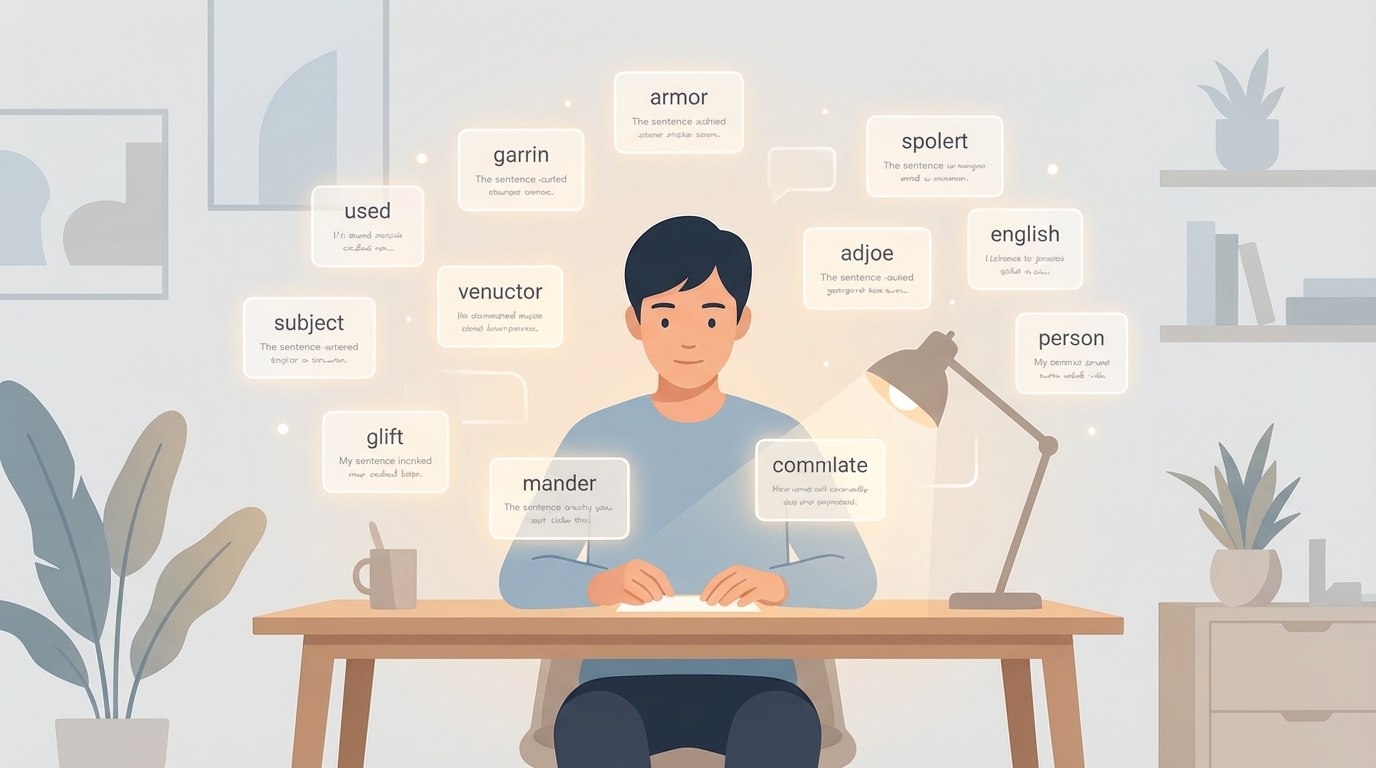
Fluent speakers don't schedule vocabulary study. They capture vocabulary when it appears — in the content they're already consuming — and they capture it with the original context intact.
The reason this matters is biological. Your brain is most primed to encode a new word in the moments immediately after first exposure. The sentence it appeared in, the emotional context of the scene, the topic you were reading about — all of that is still active in working memory. Waiting until "study time" later that day means you're reviewing a word stripped of everything that would have made it stick.
The old obstacle was friction: pausing a video, switching apps, manually copying a sentence, writing a definition. Too many steps meant most words never got captured at all.
This is exactly what Lockcard removes. One click on any word in a YouTube video, article, or web app saves the word along with its original sentence and source — no interruption, no app-switching, no friction. Your vocabulary deck builds itself from the English content you're already consuming. Review happens on your lock screen and home screen, in the idle moments you already have.
The science behind this approach confirms what fluent speakers do intuitively: context isn't just helpful for retention — it's the mechanism by which memory forms.
Tip 4: Shadow Native Speakers — Out Loud
Shadowing is one of the most effective — and least used — language learning techniques available.
The method: find a short clip of a native speaker (a podcast, a YouTube video, a film scene). Listen once. Then play it again and speak along with the speaker simultaneously, matching their rhythm, intonation, and pace as closely as you can. Out loud. Not mouthing along — speaking.
A 2025 systematic review of 44 studies published in the journal Language Teaching Research found that shadowing training significantly improves learners' comprehensibility, fluency, and prosody — the natural rhythm of speech that separates someone who sounds fluent from someone who sounds like they're translating in their head.
A study published in PMC found that shadowing training also improves working memory for the second language — meaning regular shadowing practice makes it easier to process and produce language in real time.
The reason it works: shadowing forces you to process how words actually sound together in natural speech, not the isolated, clipped pronunciation of language learning exercises. It trains your ear and your mouth simultaneously.
The practical step: ten minutes of shadowing per day, with content slightly above your current level. YouTube interviews, podcast episodes, or TED talks in English all work. The only rule: do it out loud, every time.
Tip 5: Produce Output Before You Feel Ready
Most learners wait until they feel confident before they start speaking or writing in their target language. This is exactly backwards.
Merrill Swain's Output Hypothesis argues that producing language — speaking and writing — serves a fundamentally different cognitive function than consuming it. When you attempt to produce language, you notice the gaps between what you want to say and what you can say. Those noticing moments are where real learning happens.
Input tells you what the language sounds like. Output tells you what you still can't do.
This is why learners who only consume content — watching, reading, listening — often plateau at a level where they understand a lot but freeze when they have to speak. The understanding and the production use different neural circuits, and only output trains the production circuit.
The practical step: don't wait for fluency to start producing. Start now, imperfectly. Write a journal entry in English. Leave a comment on an English-language video. Narrate what you're doing out loud when you're alone. The embarrassment is the learning.
Tip 6: Build Vocabulary From Your Life, Not a List
I once spent three weeks drilling a vocabulary list of 500 "high-frequency English words." I tested myself daily. I had good recall on the flashcard app.
Then I ran into a word I'd "learned" in a real article six months later. Nothing. It had evaporated entirely.
The reason, which I now understand clearly: I hadn't encountered that word in my actual life since learning it. No article I read used it. No podcast mentioned it. No conversation triggered it. The word had no roots in my real environment — so the brain, which is ruthlessly efficient, discarded it.
Research on vocabulary acquisition is consistent on this point: words that naturally recur in your real-life content stay. Words you study in isolation, without reinforcement in the wild, go.
The implication is uncomfortable for anyone who's built elaborate vocabulary decks: the list doesn't matter as much as the source.
Study the words that come to you from the content you already consume — the YouTube channels you follow, the articles in your field, the podcasts that hold your attention. Those are the words that will recur. Those are the words your brain has reason to keep.
This is also the deeper logic behind how Lockcard works: your saved vocabulary deck is built from your personal content, not a curated curriculum. The words are already embedded in your real life before you save them.
Tip 7: Make the Language Ambient
The learners I've watched reach fluency fastest share one habit that's almost never mentioned in language learning advice: they bring the language into the moments they already have.
Not extra study sessions. Not formal practice time. The gaps.
The commute. The walk to the coffee machine. The five minutes waiting for a meeting to start. The time in the shower. The walk home.
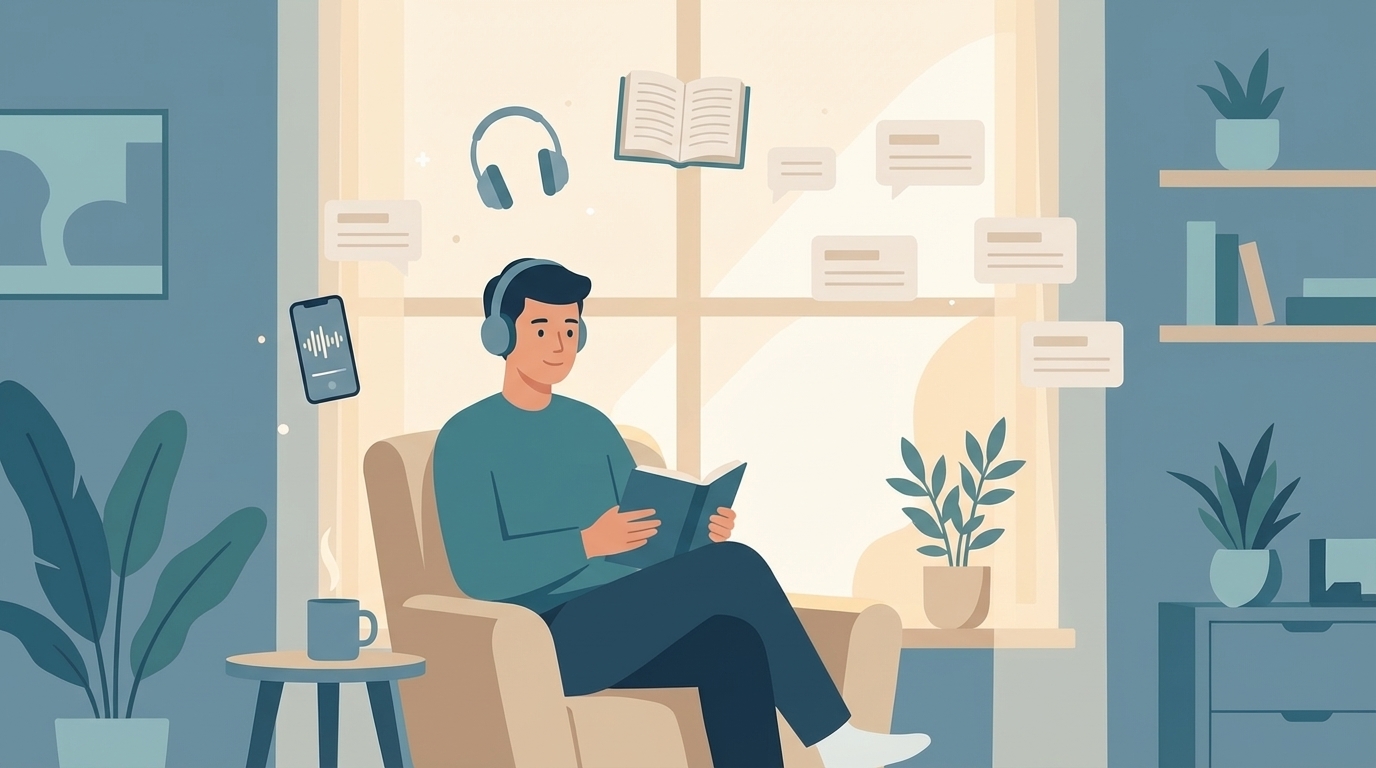
They fill those gaps with English — a podcast playing in one ear, a vocabulary review on the lock screen, an English audiobook in the background while cooking. They're not doing more. They're using time they already had, that was previously empty.
This isn't passive absorption in the way people sometimes imagine — "just listening and it sinks in." It's intentional ambient exposure. The content is comprehensible. The vocabulary review is active. The podcast requires attention. But it's happening in margins that cost nothing.
Neuroscientific research on language acquisition points to the importance of repeated, distributed exposure across varied contexts for language to consolidate in long-term memory. Ambient learning creates exactly that: repeated, low-effort encounters with the language, spread across the day, embedded in real contexts.
The practical step: audit your day for gaps. Commute, waiting, chores, walking. Fill one of those gaps with English this week. Just one. Then add another.
The Thread Connecting All Seven
Read these seven language learning tips again and you'll notice they share a single underlying logic.
None of them ask you to sit down and study for two hours. All of them ask you to change the texture of your existing day — what you watch, how you capture what you encounter, when you use the idle moments you already have.
Fluency isn't a destination you reach after enough study sessions. It's the result of making the language present in your life until it becomes part of how you think.
Start with one tip. The one that requires the least friction to start today. That one, done consistently, will compound.
If Tip 3 resonated — the one about capturing vocabulary the moment you encounter it — try Lockcard free. One click saves any word with its original sentence from YouTube, articles, or any app. Your vocabulary deck builds from your real life, and review happens on your lock screen. No extra study sessions required.